Retirement savings by age, and the point where you can stop
What people really have saved in 2025, the on-track milestones planners use, and how much you'd need at 30, 40, 50 or 60 to stop saving and let growth finish the job.
Updated October 16, 2026 · 8 min read · By Coast FIRE Planner
The short answer
Fidelity's benchmark is 1x your salary saved by 30, 3x by 40, 6x by 50, 8x by 60 and 10x by 67, assuming you keep saving about 15% of your pay. Federal Reserve figures on retirement savings by age show families with retirement accounts averaging $48,400 under 35 and $670,200 at 55 to 64 in 2025.
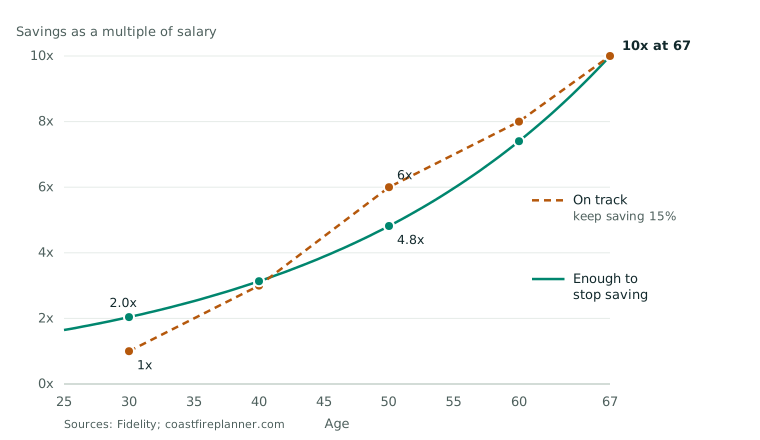
The milestones tell you whether you're on track if you keep saving until 67, and the averages tell you what other people have, which is a low bar. Neither gives the amount at which you could stop saving and let growth finish the job. For a goal of 10x salary at 67, that's about 2.0x salary at 30, 3.1x at 40, 4.8x at 50 and 7.4x at 60, using our default 7% return and 2.5% inflation.
What people actually have saved
The Federal Reserve's Survey of Consumer Finances, run every three years, asks a random sample of families what they own and owe. The 2025 results came out on October 9, 2026. Across all ages, 54.9% of families had a retirement account. Among them, the median balance was $106,000 and the mean was $451,100.
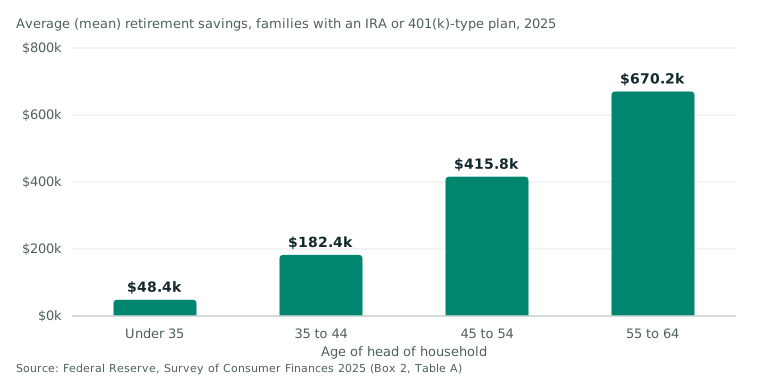
These are averages, and averages run high. A few very large balances pull them up, the same way a billionaire walking into a coffee shop turns the average customer into a millionaire. The report doesn't publish median balances by age, but across all ages the $106,000 median was less than a quarter of the mean. About half of the youngest families have no retirement account at all, and they aren't in these figures.
| Age of head of household | Average retirement savings, 2022 | Average retirement savings, 2025 | Median family income, 2025 | Median net worth, 2025 |
|---|---|---|---|---|
| Under 35 | $53,800 | $48,400 | $67,800 | $33,000 |
| 35 to 44 | $154,800 | $182,400 | $97,000 | $155,600 |
| 45 to 54 | $342,700 | $415,800 | $108,900 | $253,700 |
| 55 to 64 | $588,500 | $670,200 | $92,400 | $411,900 |
Retirement savings here are means for families with an IRA or a 401(k)-type plan; income and net worth are medians for all families. Fidelity's own data point the same way: its 401(k) savers aged 60 to 64 had an average balance of $257,400 as of March 31, 2026. That's one account at one provider, not a household's total.
On-track benchmarks: savings as a multiple of salary
Planners often express targets as a multiple of your salary, so the same rule works at $50,000 or $150,000. The best known is Fidelity's: 1x your salary by 30, 3x by 40, 6x by 50, 8x by 60 and 10x by 67. It assumes you:
- save 15% of your income every year from age 25, counting any employer match;
- keep more than half of your savings in stocks on average;
- retire at 67 and want to keep your pre-retirement lifestyle.
Fidelity's model also plans for a 90% chance of success in poor markets and assumes your pay grows 1.5% a year faster than inflation. The multiples also assume you spend roughly what people at your income usually spend. If you spend much less, you need less, which is why FIRE planners start from spending instead of salary. Our FIRE calculator works that way.
How much should I have saved by 30?
By Fidelity's benchmark, 1x your salary. A household earning the 2025 median for families under 35, $67,800, would aim for roughly $68,000. That compares with the $48,400 average among young families who have a retirement account.
If you're well short, 30 is still when each dollar has the most time to grow. $100,000 invested at 30 grows to about $450,000 in today's money by 65, at a 7% return and 2.5% inflation, without another dollar added.
How much should I have saved by 40, 50 and 60?
- By 40, 3x your salary. The average for families aged 35 to 44 with retirement accounts was $182,400 in 2025, against a median family income of $97,000.
- By 50, 6x your salary. Families aged 45 to 54 with accounts averaged $415,800.
- By 60, 8x your salary. Families aged 55 to 64 with accounts averaged $670,200.
Each step assumes you keep saving 15% until 67, so none of them says when you could stop.
How much you need at each age to stop saving
Coast FIRE is the point where you have enough invested that growth alone will reach your retirement goal, so your paycheck only has to cover today. Holding Fidelity's 10x-at-67 goal fixed, here is how much you'd need at each age to stop saving entirely, next to the on-track milestones:
| Age | On track, keep saving 15% | Enough to stop saving | On an $80,000 salary: on track | On an $80,000 salary: stop saving |
|---|---|---|---|---|
| 30 | 1x | 2.0x | $80,000 | $163,182 |
| 40 | 3x | 3.1x | $240,000 | $250,768 |
| 50 | 6x | 4.8x | $480,000 | $385,364 |
| 60 | 8x | 7.4x | $640,000 | $592,203 |
| 67 | 10x | 10x | $800,000 | $800,000 |
At 30, stopping takes about twice the on-track amount, because you'd be giving up 37 years of contributions. The lines meet around 40, and after that Fidelity's milestones run higher. The gap comes from the assumptions: Fidelity plans for a 90% chance of success in poor markets and a shift toward bonds, while our amount uses a 7% average return, which makes it roughly a 50/50 point (our Monte Carlo guide explains why). Treat the stop-saving line as the minimum and aim above it.
The example holds your salary and the 10x goal in today's money. Your own target should come from what you plan to spend, and the Coast FIRE number calculator shows it for every age.
If you're behind
Judging by the averages above, most families are below Fidelity's milestones, so you're in large company. The levers that matter most:
- Collect the full employer match. Fidelity's 15% includes it, and it's part of your pay.
- Raise your savings rate when your pay rises, so the increase never reaches your spending.
- Cut fees: a 1% fee does as much damage as a 1-point lower return (see how investment fees delay your FIRE date).
- Retire a little later. Each extra year adds a year of saving and growth and removes a year of spending.
Our guide on how to reach Coast FIRE faster measures each lever in months saved.
If you're ahead
If your savings are above the stop-saving line for your age, you may already be able to stop saving for retirement. Check it with the Coast FIRE calculator, which shows the month you can coast and your odds across 1,000 simulated markets. Then read what to do after you reach Coast FIRE before you change anything at work.
Sources
The stop-saving multiples and dollar examples are our own calculations, explained on our methodology page. The other figures come from these sources, checked on October 16, 2026:
- Changes in U.S. Family Finances from 2022 to 2025: Evidence from the Survey of Consumer Finances. Board of Governors of the Federal Reserve System, 2026. Released October 9, 2026. Mean retirement savings by age (Box 2, Table A), median income (Table 1) and median net worth (Table 2) by age, in 2025 dollars.
- Federal Reserve Board releases results of the 2025 Survey of Consumer Finances. Board of Governors of the Federal Reserve System, 2026.
- How much do I need to retire?. Fidelity Investments, 2026. Save 1x your salary by 30, 3x by 40, 6x by 50, 8x by 60 and 10x by 67, saving 15% a year from age 25.
- Average retirement savings by age. Fidelity Investments, 2026. Average 401(k) balances by age for Fidelity plan participants, as of March 31, 2026.
Questions
At what age should you have $100,000 saved?
On Fidelity's milestones, someone earning $100,000 would have it by 30 (1x salary), and someone earning $50,000 somewhere between 30 and 40 (1x at 30, 3x at 40). Hitting it early helps a lot: $100,000 invested at 30 grows to about $450,000 in today's money by 65 at a 7% return and 2.5% inflation, without another dollar added.
Is having $100k saved at 30 good?
Yes. It's at or above Fidelity's 1x-salary milestone for anyone earning up to $100,000, and about double the $48,400 average for families under 35 that have a retirement account. On its own, it grows to roughly $450,000 by 65 in today's money, enough to fund about $18,000 a year at a 4% withdrawal rate.
Is $200k in a 401(k) good at 30?
It's well ahead of the benchmarks: about three times the 2025 median income for families under 35 ($67,800). At a 7% return and 2.5% inflation it grows to about $900,000 in today's money by 65 with no more saving, enough for about $36,000 a year at 4%. Depending on what you plan to spend, that can already be close to Coast FIRE.
What is the average 401(k) balance at retirement age?
Fidelity reports an average 401(k) balance of $257,400 for its savers aged 60 to 64, as of March 31, 2026. That's one account at one provider. Counting all retirement accounts, the Federal Reserve's 2025 survey found an average of $670,200 for families aged 55 to 64 that have an IRA or a 401(k)-type plan.
What is considered a good retirement nest egg?
One that covers your spending. A common rule of thumb is 25 times the yearly spending your savings must fund, which is the 4% rule: $40,000 a year needs about $1,000,000. Early retirees often use 3% to 3.5% for extra margin, which raises the target to about 29 to 33 times spending.
How much should I have saved by 40?
Fidelity's benchmark is 3x your salary by 40, assuming you keep saving about 15% of your pay until 67. To be able to stop saving at 40 and still reach 10x salary by 67, you'd need about 3.1x at a 7% return and 2.5% inflation, so at 40 the two targets are nearly the same.